Sunken Pavers in Cape Coral: Causes and How Re-Leveling Works
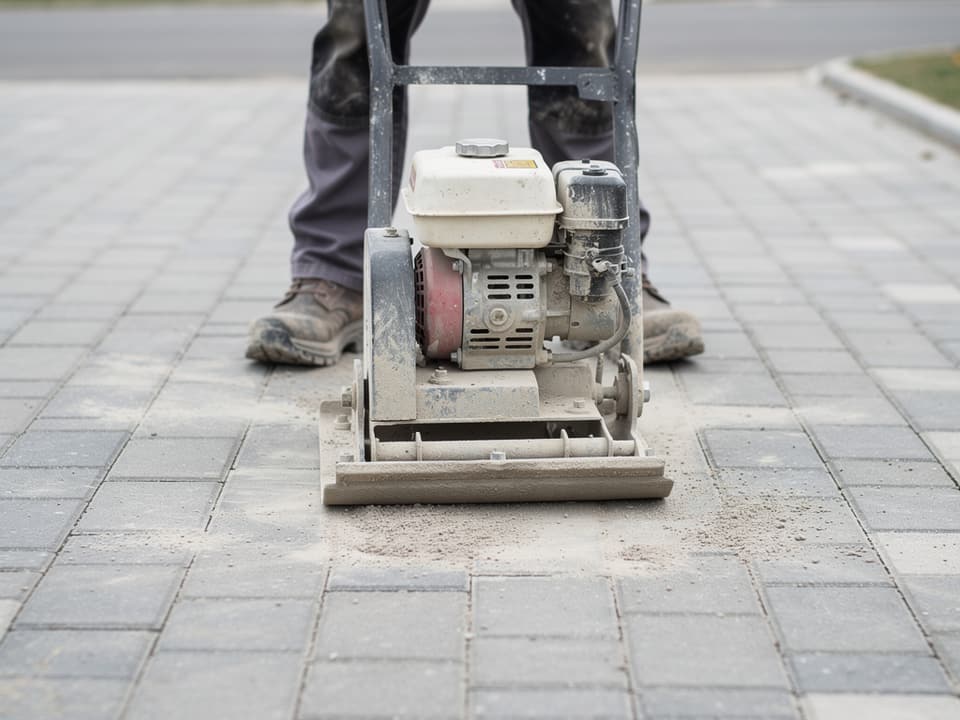
The dip is the symptom
A sunken patch in a paver driveway is the last thing to happen, not the first. By the time a dip holds a puddle, something underneath has been losing support for months, and in almost every case the something is water.
Our paver repair page covers what fails beneath the surface. This guide is the part you can do before anyone comes out: reading what the shape of the dip tells you, finding where the water is coming from, and knowing what a re-level should involve, so you can tell a repair that lasts from one that will be back next summer.
Read the shape of the dip
The outline of a sunken area says a lot about its cause, and it takes a minute to read.
A long, shallow dip along an edge
The outer row of pavers is drifting outward and the field behind it is following. That points to a missing or failed edge restraint, covered on our brick pavers page. Re-levelling the dip without fixing the edge only buys a season or two.
A straight line of settlement across the driveway
Dips rarely run in straight lines by accident. A narrow, straight sunken band usually sits over a trench: a water line, an irrigation line, a cable or a plumbing repair, dug after the driveway went in and backfilled without proper compaction. If anyone has dug under the driveway in the past few years, start there.
One paver, or a small circle
A single sunken paver or a tight circle a foot or two across is often a point load rather than a base failure. Cape Coral is a boat city, and a trailer's tongue jack resting on one paver puts a great deal of weight on a very small area. So does a ladder foot, a roll-off dumpster wheel during a renovation, or a car jack. If the dip sits exactly where something heavy has stood, the cause is not a mystery.
A broad, saucer-shaped low spot
The classic washout: water has been getting under the surface over a wide area and carrying the bedding sand away. This is the one that needs the water source found before anything else.
A ridge rather than a dip
If the pavers have lifted rather than sunk, it is almost always roots, which the repair page covers.
Find the water before anyone touches the pavers
Re-levelling over an active water source is paying to do the job twice. These are the places to check, roughly in the order they cause trouble here.
Irrigation
Much of Cape Coral waters its lawns from the city's separate irrigation-water lines on a set schedule, so a sprinkler head aimed at the driveway, or a cracked line near its edge, delivers water to the same spot on the same days for years. Run each zone while you watch the driveway edge. Overspray onto the pavers is easy to see; a cracked line shows up as a patch of lawn that stays green and soft when the rest has dried.
The air conditioner condensate line
In Southwest Florida the AC runs most of the year, and its condensate line drips steadily wherever it was routed. If that is onto a paver patio, a walkway or the edge of the driveway, it is a small, constant water source working at one spot all year. It is also one of the easiest fixes here: extend the line, or redirect it onto gravel or lawn.
Downspouts
A rainy-season downpour off a full roof is a lot of water arriving at one corner in a short time. A downspout that discharges straight onto pavers cuts a channel under them. An extension or a splash block costs less than any re-level.
The pool
If the low spot is on a pool deck near the coping, check how much water the pool is losing. A pool losing noticeably more than evaporation explains may have a leak, and a leak under a deck undermines the base faster than anything else on this list. That is a job for a leak-detection company first and a paver crew second.
The street side
If the dip is at the apron, the usual culprit is the swale and the street rather than anything on your lot. The repair page goes into the apron specifically.
The quickest way to see all of it at once is to walk the driveway during, or straight after, a heavy afternoon storm. Note where the water runs, where it pools and where it disappears, and you will usually have the answer in five minutes.
What a proper re-level involves
Knowing the steps makes quotes easy to compare. A re-level that lasts starts with the water source, dealt with or at least named in the quote. The pavers are then lifted past the edge of the dip, not only at its lowest point, because the base has usually failed wider than the visible sag.
The old bedding sand comes out, since it has already failed. Where the base has lost volume, base material is added and compacted in layers. That step is what separates a repair from a patch. Fresh bedding sand is screeded level with the surrounding surface.
The original pavers then go back in their original pattern. Interlocking pavers are made to be lifted and re-laid, which is their main advantage over poured concrete. Finally the joints are refilled and the area is compacted, so the patch locks into the field around it.
Questions worth asking on a quote
How far beyond the visible dip will you lift? What will you do about the base, as opposed to the sand? What do you think is causing it, and does the quote deal with that? Will you reuse my pavers?
"We will just add sand under it"
Topping up the bedding sand without touching the base levels the surface for a while. The dip comes back, usually by the next rainy season.
"We can inject foam"
Polyurethane foam and mudjacking are methods for lifting concrete slabs. A paver surface is hundreds of separate units on sand, and the right repair is to lift them and fix what is underneath.
What you can reasonably do yourself
A single sunken paver on a walkway, away from vehicle traffic and away from the pool, is a fair weekend job: lift it, add and tamp bedding sand until it sits a fraction proud of its neighbours, set it back, refill the joints and tamp it down. The first paver out is the hard one. Anything on a driveway, anything on a pool deck, anything bigger than a few pavers, or anything where the base has clearly gone is worth having done properly, because a driveway re-level done badly becomes a second re-level.
When it is more urgent than it looks
Three situations move a dip up the list. A trip hazard on a walkway or entry path, especially on a home with guests or tenants coming and going. A low spot next to the pool coping, where a settling deck can pull away from the pool edge and let water in behind it. And a dip that holds water against the house, which sends water toward the slab rather than away from it.
Timing
Unlike sealing, re-levelling does not need the dry season. It can be done in summer, and it is better done before another summer of storms widens the washout. If the driveway is also due a seal, the usual order is to re-level now and seal on the dry-season calendar. If you have found a dip and found the water, tell us where the driveway is and what you have seen, and where one is available we will put you in touch with a company that does this kind of repair in your part of Lee County.
Where to go next
- Paver repair and re-leveling in Cape Coral
- Brick pavers and edge restraints
- Pool deck and lanai pavers
- Pavers after a storm
Common questions
Can sunken pavers be fixed with foam injection?
Foam and mudjacking are for concrete slabs. Pavers sit on sand as separate units, so the lasting repair is to lift them, fix the base and re-lay them.
How far around a dip should be lifted?
Past its edge. The base under a sunken area has usually failed wider than the visible sag, and stopping at the lowest point leaves a weak ring around the repair.
Should I fix the downspout or irrigation before the re-level?
Yes, or at the same time. A re-level over an active water source is a repair with a countdown on it.
Is re-leveling a rainy-season job?
It can be. Unlike sealing, it does not depend on dry weather to cure, and doing it before more storms arrive limits how far the washout spreads.