How Often Should Pavers Be Sealed in Cape Coral?
The standard answer, and why it lands badly here
Search the question and you get two to three years, everywhere, for everyone. That number comes from national manufacturer guidance, and manufacturer guidance has to hold in Ohio and Arizona at the same time. It is an average of climates that have nothing to do with each other.
Cape Coral sits outside that average in three ways at once. There is salt in the air across most of the city. There is a rainy season that moves a lot of water across a driveway in a short time. And there is sun at an intensity that breaks sealer down from above while the water works on it from below.
Two driveways in this city, laid the same year by the same crew, can sit years apart on when they next need doing. So the useful question is not how often in general. It is what sets the interval on the driveway you own, and there are two answers: where it is, and which way it faces.
Distance from water sets the starting point
Salt is the biggest single factor, and it is the one people underrate most, because they assume it is a canal-front problem. In this city the canals run close behind almost every street, so very few driveways are clear of it. Our guide on why Cape Coral paver joints fail faster than inland covers what the salt does inside a joint.
For the interval, the point is simpler. Distance from open water decides where on the range you start. It moves the number. It does not exempt anyone.
Which way the driveway faces
This is the factor almost nobody accounts for, and it costs the most.
A west-facing driveway in Cape Coral takes the full afternoon sun, in the part of the day when it is strongest, every day of the year. UV degradation of an acrylic sealer is cumulative. A driveway on the west side of a house can lose its finish visibly sooner than an identical driveway on the east side of the same street.
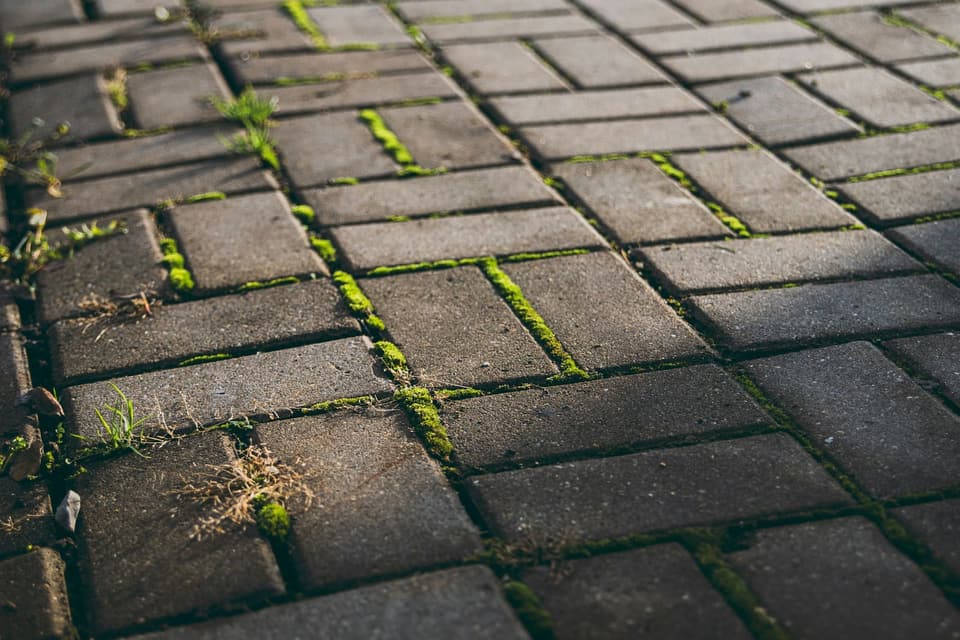
North-facing driveways have the opposite problem. They hold shade and moisture, which is easier on the sealer and much friendlier to organic growth. That green film in the low corner is not a sealer failure, but it does mean the surface is staying wet, and it is worth cleaning off well before it is worth re-sealing.
Shade from a mature oak or a two-storey neighbour changes the arithmetic again. A driveway shaded through the afternoon asks far less of its sealer than the one next door.
Roughly what the interval looks like, by where you are
These ranges assume the last seal was done properly and the driveway gets rinsed now and then. They are a starting point for looking at your own surface, not a schedule to put in the diary.
Matlacha and Pine Island: the shortest
Open water on effectively every side and salt air with nothing in between. Two years is a realistic interval out there, and some surfaces want attention sooner.
Cape Harbour, Tarpon Point and the southwest Cape
Direct Gulf access puts salt at the high end of what the mainland sees. Many of these surfaces are pool decks and walkways held to a standard where appearance matters as much as condition, which pulls the interval in further.
Yacht Club, Pelican and the older canal neighbourhoods
The middle of the range. Much of the paver work in the southeast Cape is on driveways laid two decades ago, and older pavers with a history of settling are judged more on condition than on the calendar.
Sandoval and the newer gated communities
These stretch further, because the surfaces are newer and the sealing is preventative rather than restorative.
Inland Fort Myers: the longest
Further from open water, more tree cover, less of the constant salt load. Three years or more is reasonable, which is why Fort Myers gets treated as a different maintenance problem from Cape Coral rather than a bigger version of it.
The screwdriver test, which beats all of the above
Every range above is a prediction. The joint sand is evidence, and it takes about ninety seconds to read.
Take an ordinary flathead screwdriver out to the driveway and push the tip straight down into the sand between two pavers with steady hand pressure. Do not lever it or hammer it. Do it in three places, because one reading tells you almost nothing: at the apron, where the driveway meets the road and takes the most turning; at the lowest corner, wherever water leaves the driveway; and somewhere in the middle, on a stretch that gets neither.
It barely goes in
The joints are full and the sand is bound. The surface is not asking for anything yet. Check again next season.
It goes in a quarter-inch or so and stops
Normal wear. This is where cleaning, re-sanding and sealing is ordinary maintenance, and it is the cheapest point at which to do it.
It sinks in easily, or the sand is loose and dry
The joints have lost their structure. Sealing over this without re-sanding first spends money on appearance and nothing else.
It goes in and the paver beside it rocks
Stop there. Something underneath has moved, and a surface that moves underfoot needs re-levelling before sealing is worth discussing at all.
The last two are the readings worth acting on, and they are the two a glance from the front door will not give you.
New pavers are a separate question
If the driveway went in within the last year or so, and especially along the Burnt Store corridor where much of the newer construction sits, a white bloom on the surface is probably efflorescence: mineral salts rising out of the concrete as it cures. It is normal and temporary, and sealing over it too early traps it under the film where it is much harder to deal with. New pavers generally want a curing period before their first seal, and a company pushing to seal a driveway laid last month is not doing it a favour.
What to do with this
Run the screwdriver test at the three spots. If the sand is holding, put it out of your mind until next season. If it is not, book the work for the dry season, October through April, when sealer can cure properly. The calendar fills from October and the good crews fill first. Tell us where the driveway is and which way it faces, and where one is available we will put you in touch with a company that works that part of the city.
Where to go next
- Paver sealing in Cape Coral
- What salt does inside a paver joint
- Matlacha and Pine Island
- What paver sealing costs in Cape Coral
- Why inland Fort Myers can wait longer
Common questions
So is every two to three years wrong?
It is a reasonable middle, and wrong at both ends. On Matlacha and Pine Island it is too long; inland it can be too short. The screwdriver test tells you which side of the middle your driveway is on.
Does a west-facing driveway really need sealing sooner?
Usually, yes. It takes the strongest sun of the day every day, and UV is what wears an acrylic sealer down. Two identical driveways on opposite sides of a street commonly end up on different schedules.
Do the joints need re-sanding every time the pavers are sealed?
No. If a screwdriver barely goes into the joint, a clean and a seal is enough. If it sinks in, re-sand first, because sealer over empty joints does nothing structural.
How soon can new pavers be sealed?
Not straight away. New pavers usually need a curing period first, and any white bloom from efflorescence should be dealt with before sealer goes on, or it gets trapped underneath.